


REACH Update
The European Commission has amended Annex II of REACH, concerning the compilation of Safety Data Sheets (SDSs). Safety Data Sheets don’t change very often – this is an uncommon and important update.
The regulation aligns REACH Annex II with the 6th and 7th revisions of GHS, and brings in a number of modifications to SDSs. The latest amendment to Annex II was published in the Official Journal on 26th June 2020 (Regulation (EU) 2020/878).
Deadlines
The regulation applied from 1st January 2021, which means that all new SDSs, authored after this date, must take into account the new requirements.
All existing SDSs, authored before January 2021, will still be valid until the grace period ends on 31st December 2022 (except for bulk mixtures requiring an UFI). After this date, all Safety Data Sheets will need to be updated to the new requirements.
Organisations should start the process of updating their SDSs now.
The Changes in SDS Requirements
The main provisions of the new revised Annex II are:
- The alignment of Safety Data Sheets with UN GHS Revisions 6 & 7.
- The alignment with requirements for nanomaterials.
- To clarify requirements related to Poison Centres (Unique Formula Identifiers (UFIs)).
- Additional information for substances and mixtures with endocrine-disrupting properties.
- The addition of Specific Concentration Limits (SCLs), M-factors and Acute Toxicity Estimates.
The main sections of the SDS which have undergone revision are 1, 2, 3, 9, 11 and 12, with sections 3 and 9 seeing the biggest changes:
Changes by SDS Section
| SDS Section | New requirements | ||||||||||||||||||||||||||||||||||||||||
|---|---|---|---|---|---|---|---|---|---|---|---|---|---|---|---|---|---|---|---|---|---|---|---|---|---|---|---|---|---|---|---|---|---|---|---|---|---|---|---|---|---|
| Section 1.1 Product identifier | If your SDS pertains to one or more nanomaterials (or materials including them) you must now state this using the term ‘nanoform’.
You must now provide the substance’s Unique Formula Identifier (UFI) for certain hazardous mixtures that are not packaged or bulk mixtures supplied for use at industrial sites. (this excludes non-hazardous mixtures, or environmentally-classified mixtures). The requirement to assign a UFI to a product comes from Annex VIII of the Classification, Labelling and Packaging of substances and mixtures (CLP) Regulation (EC) No 1272/2008 and is part of the process for poison centre notifications. As per Annex VIII, UFIs assigned to hazardous mixtures for industrial use and to unpackaged mixtures have to be included in their respective SDSs. This requirement is mandatory and not subject to the same implementation timeline as the rest of the new Regulation. The UFI should go under Other means of Identification in Section 1.1 |
||||||||||||||||||||||||||||||||||||||||
| Section 2.3 Other hazards | It will become mandatory to state in section 2.3 if a substance has endocrine disrupting properties according to Regulation (EU) 2017/2100.
If your chemical is a mixture, information must be provided for each constituent endocrine-disrupting substance at a concentration equal to or greater than 0.1% by weight. This property will be assessed based on a list established in accordance with REACH Article 59(1), EU Regulation 2017/2100(3) and EU Regulation 2018/605. This will also be applicable to substances in mixtures that are present at or above 0.1% and have been identified as having endocrine disrupting properties according to the following lists: Endocrine disruptors test methods, & corrigendum. |
||||||||||||||||||||||||||||||||||||||||
| Section 3.1 Substances | For pure chemical substances, you must now provide product information on the Specific Concentration Limits, the Multiplying-factors and the Acute Toxicity Estimates.
If the substance is registered and it covers a nanoform, the particle characteristics that specify the nanoform, as described in Annex VI, shall be indicated. If the substance is not registered, but the SDS covers nanoforms, the particle characteristics of which have impact on the safety of the substance, those characteristics shall be indicated. |
||||||||||||||||||||||||||||||||||||||||
| Section 3.2 Mixtures |
For hazardous mixtures, there are changes to the list of hazard classes, hazard categories and concentration limits for which a substance must be listed if it’s part of a mixture intended for the consumer. Look into the details of these changes to ensure you continue to fulfil all requirements. Threshold concentrations for inclusion in Section 3.2 have been reduced for some hazards: • Aspiration hazard: from 10% to 1% Also – for all the substances given in 3.2 — the Specific Concentration Limit, the Multiplying-factor and the Acute Toxicity Estimate for the substance in Part 3 of Annex VI to Regulation (EC) No 1272/2008 or as determined in accordance with Annex I to that Regulation shall be indicated, if available — if the substance as used in the mixture is in nanoform and is as such registered or addressed by the downstream user chemical safety report, the particle characteristics that specify the nanoform, as described in Annex VI, shall be indicated. If the substance as used in the mixture is in nanoform but is not registered or addressed by the downstream user chemical safety report, the particle characteristics which have impact on the safety of the mixture, shall be provided. For nanoform components, the same characterisation requirements detailed 2 for section 3.1 of 3 the SDS apply (see Table 1.1 of the guidance).
|
||||||||||||||||||||||||||||||||||||||||
| Section 9 Physical and chemical properties | The list of properties you must detail about your chemical substance in Section 9 has been updated – much more detail is required by the Regulation when describing the results of physico-chemical testing.
Sub section 9.1. Information on Basic Physical & Chemical Properties has been updated — they now should be: (a) Physical state There are requirements within sub section 9.2 to add certain properties if they are relevant for safe use. Section 9.2 is divided into two new sub-sections:
Sub-section 9.2.1 Information with Regard to Physical Hazard Classes – a new sub section with additional information on the physical hazard classes including properties, safety characteristics and test results which may be included in the SDS. (a) Explosives (b) Flammable gases (c) Aerosols (d) Oxidising gases (e) Gases under pressure (f) Flammable liquids (g) Flammable solids (h) Self-reactive substances and mixtures (i) Pyrophoric liquids (j) Pyrophoric solids (k) Self-heating substances and mixtures (l) Substances and mixtures, which emit flammable gases in contact with water (m) Oxidising liquids (n) Oxidizing solids (o) Organic peroxides (p) Corrosive to metals (q) Desensitised explosi
Sub-section 9.2.2 Other Safety Characteristics – much more detailed recommendations (but not mandatory): safety characteristics and test results for the hazard classes in which the product is classified, eg for aerosols: total percentage by mass of flammable components; for flammable liquids: information on sustained combustibility may be provided: (a) mechanical sensitivity; (b) self-accelerating polymerisation temperature; (c) formation of explosible dust/air mixtures; (d) acid/alkaline reserve; (e) evaporation rate; (f) miscibility; (g) conductivity; (h) corrosiveness; (i) gas group; (j) redox potential; (k) radical formation potential; (l) photocatalytic properties.
Other updates to Section 9 include: Physical and chemical parameters shall be indicated if their indication is relevant for the safe use of the substance or mixture. New improved wording regarding information requirements and clarification on the measurement units to be used. Reasons for omissions of data to be clearly indicated. Additional information is provided for each property. Partition coefficient n-octanol/water ( log value) for nanoforms the dispersion stability in different shall be indicated. New sub-heading: Particle Characteristics for solids, including particle size, or size distribution, and description of any nanoforms. The method of determination shall be provided, including measurement and reference conditions. The recommended list order of the properties has changed. Sub-heading 9.1 ‘Appearance’ has been split into ‘physical state’ and ‘colour’. Colour: for variations on colour range of products, use ‘various’ to describe colour. ‘Odour‘ and ‘odour threshold‘ have been combined. Melting point and boiling point: indicate if decomposition or sublimation occur before or during melting or boiling. Sub-heading ‘Initial boiling point and boiling range’ changed to ‘Boiling point or initial boiling point and boiling range’. Flammability: now applies to solid, liquids and gases (previously only solids and gases). Indicate if substance or mixture is ignitable (ie can be set on fire, even if not classified for flammability). Sub-heading ‘Upper/lower flammability or explosive limits’ changed to ‘Lower and upper explosion limit’. Flash point: either the Fp of the mixture, otherwise that of the substance with the lowest Fp shall be indicated. Auto-ignition: either the auto-ignition temperature of the mixture, otherwise that of the substance with the lowest auto-ignition temperature shall be indicated. Decomposition: give the temperature, or ‘no decomposition observed up to x °C’. Sub-heading Density changed to Density and/or relative density. Sub-heading Vapour density changed to Relative vapour density. |
||||||||||||||||||||||||||||||||||||||||
| Section 11 Toxicological information | In Section 11, section 11.2 is added with ‘Information on other hazards’, which includes two other new sub-sections:
11.2.1 Endocrine disrupting properties: Information on adverse health effects caused by endocrine disrupting properties shall be provided, where available, for the substances identified as having endocrine disrupting properties in sub section 2.3. This information shall consist of brief summaries of the information derived from application of the assessment criteria laid down in the corresponding Regulations ((EC) No 1907/2006, (EU) 2017/2100, (EU) 2018/605), that is relevant to assess endocrine disrupting properties for human health. 11.2.2 Information on other hazards, Other relevant information on adverse health effects shall be included, even when not required by the classification criteria. |
||||||||||||||||||||||||||||||||||||||||
| Section 12 Ecological information | Addition of new sub-section, 12.6 Endocrine disrupting properties: requiring you to give product information on adverse effects on the environment caused by endocrine-disrupting properties.
Old sub section 12.6 ‘Other adverse effects’ now becomes 12.7. |
||||||||||||||||||||||||||||||||||||||||
| Section 14 Transport information | Sub-section 14.7: Title changed to ‘Maritime transport in bulk according to IMO instruments’ from ‘Transport in bulk according to Annex II of Marpol and the IBC Code’. The Regulation requires more information on bulk transportation. |
Who Do The Amendments Apply To?
UK authorities did not adopt the update to Annex II when the UK left the EU (31 December 2020). This means that one SDS will not be compliant for UK REACH and EU REACH.
If you are a manufacturer or importer of chemical substances in the UK, it is critical that you put a plan in place to ensure that your SDSs are compliant according to the regulations in both places and that you can continue trading your products in the UK and EU from 1 January 2021.
What You Need To Do
-
- If you have not started preparing for the changes, do so now!
- Begin to gather the relevant information to update your SDSs.
- Ensure that any NEW SDSs meet the new requirements.
- Ensure that you update your EXISTING SDSs in good time for the 31 December 2022 deadline.
How Can Hibiscus Help? – Prometheus Updated for REACH 2020
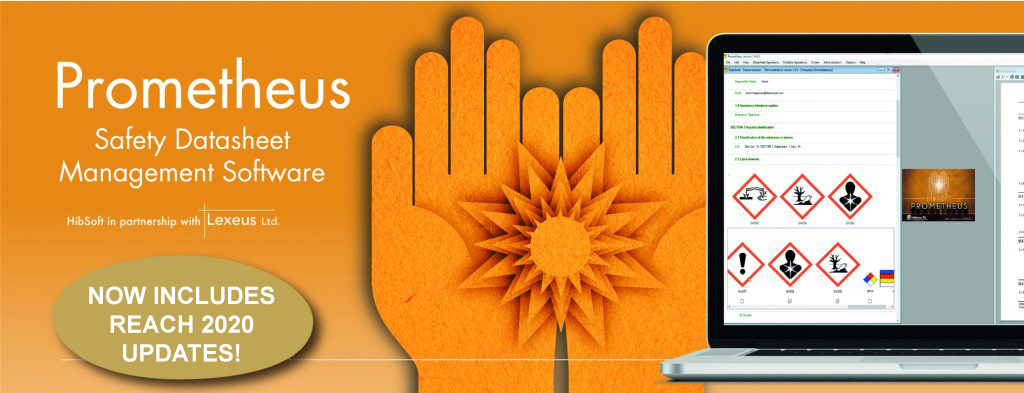
Hibiscus have designed the Prometheus SDS software package to simplify and streamline the Safety Data Sheet process, saving you time and money; Prometheus is a simple, flexible and affordable solution to the problem of creating, storing and distributing your own SDSs.
Prometheus has now been updated in order to help you comply with the latest REACH 2020 requirements:
- The mandatory headings in templates for safety datasheets have been updated to conform to REACH 2020. The big changes are in section 9, where it is now obligatory to list nine physical properties, and section 11, where 11.1 is now divided into subsections based on route of exposure. There are also small changes to various headings in most languages. Acute toxicity estimate, M-factor, and specific concentration values for substances have been added – they are now required in section 3.
- Automatic creation of tables has been changed significantly because REACH 2020 makes it obligatory to list many more properties for substances in section 3. Column widths are now minimised automatically and tables are split if necessary when they are generated automatically.
- The template for poisons centre sheets has been updated to include product category name and product category code. Automatic checks have been added to ensure that concentrations of components are given as exact values and add up to 100%.
- Extra components that are not listed in the associated SDS can now be added to a poison centre sheet.
- The phrase “This Safety Data Sheet is provided in compliance with the EC Regulations 1907/2006, 1272/2008, 2015/830 and 2020/878” is now available for use in SDS headers and section 15.1.
- The templates for non-EU datasheets remain the same, except for minor updating of the text of some headings. Automatic “translation” in either direction between REACH 2020 datasheets and earlier and non-EU ones, moves phrases appropriately between subsections that have changed.
Call 0113 242 4272 for further details, or contact us at Enquiries@hibiscus-plc.com
Resources
ECHA Guidance on compilation of SDS 2020
COMMISSION REGULATION (EU) 2017/542
Regulation (EU) 2020/878: https://eur-lex.europa.eu/legal-content/EN/TXT/PDF/?uri=CELEX:32020R0878&from=EN
Regulation (EU) 2015/830: https://eur-lex.europa.eu/legal-content/EN/TXT/PDF/?uri=CELEX:32015R0830&from=EN
Regulation (EC) No 1907/2006 (latest consolidated version): https://eur-lex.europa.eu/legal-content/EN/TXT/PDF/?uri=CELEX:02006R1907-20200428&rid=1

